
The short answer
Assess the engine, installation and drive together. A low hour reading cannot substitute for that assessment.
What you’ll work through
Identity, records and cold-start assessment
Access, cooling, exhaust and fuel
Gearbox, shaft or saildrive and propeller
Suitable loaded operation with a mechanic
Identify what is installed
Record the engine model, serial number, gearbox or saildrive details and the hour-meter reading. Compare them with invoices and manuals. Ask whether the engine, instrument panel or hour meter has been replaced, and whether the displayed hours represent the engine's entire life. Low hours are not automatically reassuring when the yacht has been inactive or poorly documented.
Ask for the maintenance record as a sequence of dates, hours and work performed. Identify the contractor and request clarification of vague entries. YANMAR directs owners to the maintenance schedule for their particular engine; do the same for whichever make is fitted. A general annual-service label does not tell you whether every model-specific task was completed.
Arrange the cold start before arriving
Ask in advance for a cold start to be available, with a competent person operating the engine. If it has already been warmed, record that and arrange an appropriate opportunity rather than drawing an immediate conclusion about the seller. Let the mechanic decide what checks are useful and how to perform them safely.
Observe the sequence and record questions about starting behaviour, instrument readings, leaks or unusual sounds. Smoke colour alone is not a diagnosis. The operating conditions, engine design and duration matter, and a mechanic may need further investigation. Keep hands, clothing and cameras away from belts, hot components and rotating machinery.
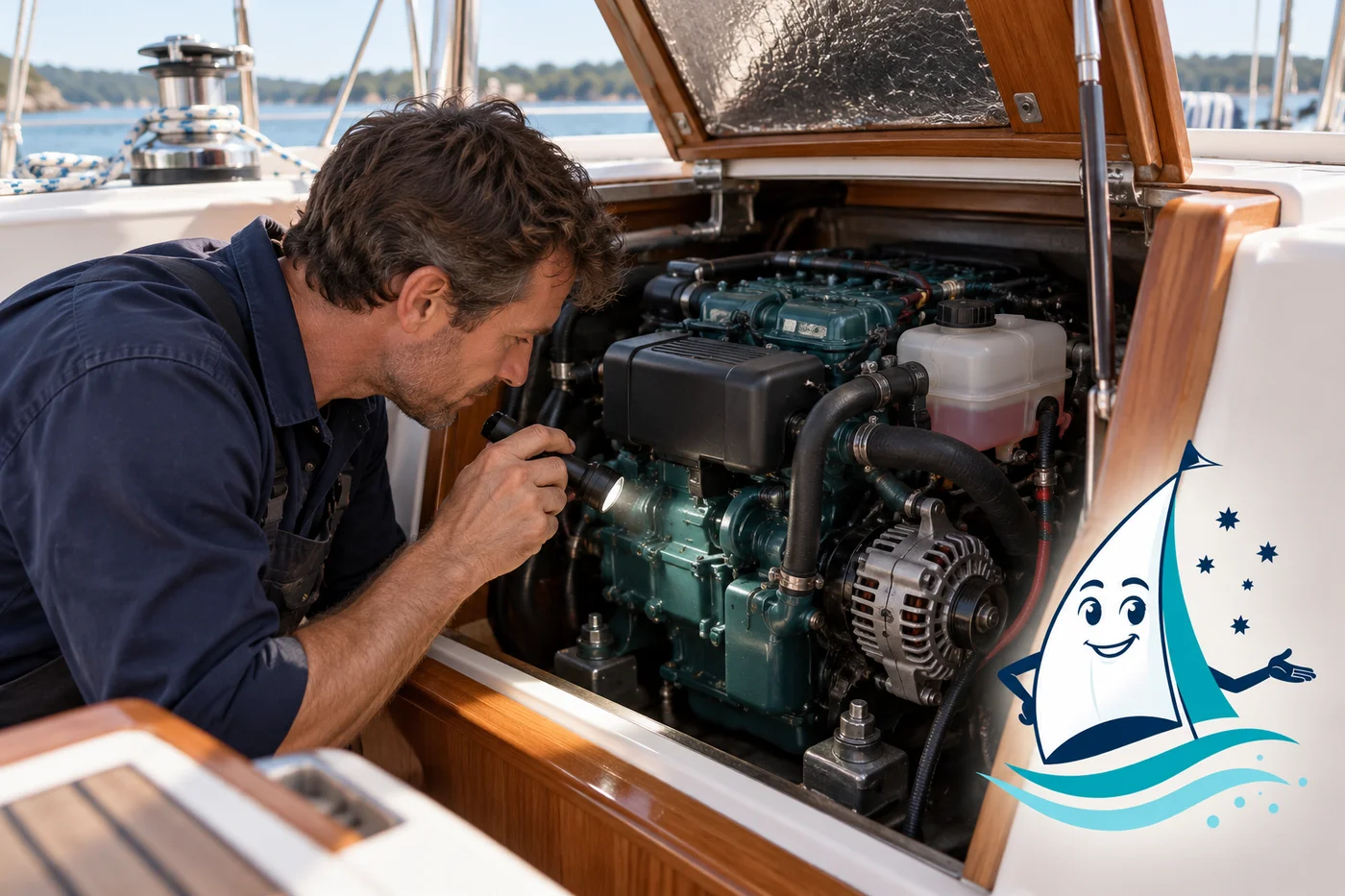
Look at the installation, not just the engine block
Access can determine whether future servicing is straightforward or costly. Ask how filters, belts, cooling components and the raw-water pump are reached. Include mounts, hoses, exhaust arrangements, fuel system and ventilation in the mechanic's scope. Fresh paint or a cleaned bilge may improve presentation without answering those questions.
Trace the history of recurring problems through invoices. Was a leak's cause repaired or was the area merely cleaned? What work followed an overheating incident? Ask for the scope of any rebuild: parts, machining, installation, testing and any applicable warranty. Rebuilt is not a precise description unless the supporting work is specified.
Include the drive system
A shaft-driven yacht brings shaft, alignment, stern gland, bearings and propeller questions. A saildrive has its own inspection and service requirements. Provide the model details and records to the mechanic and ask which tasks need a haul-out. Avoid applying one manufacturer's replacement intervals to a different drive or assuming an engine service included the drive.
Ask about corrosion-related observations, prior repairs and propeller changes. Record vibration or unusual behaviour for professional assessment rather than attributing it to a single cause. The condition of a propulsion system cannot be established by looking only at a tidy engine compartment while tied to the dock.
Observe operation under appropriate load
Agree a sea trial with the owner, surveyor and mechanic. The competent operator and specialist should select suitable tests and operating conditions. Record what was demonstrated, for how long and what could not be completed. Running briefly in neutral does not establish how the system behaves during normal motoring.
If conditions prevent a meaningful test, decide whether to reschedule or accept a documented limitation. A short trial cannot prove reliability across every future passage. Your aim is to reduce uncertainty enough for an informed purchase and identify further work, not to obtain a promise that nothing will ever fail.
Compare repair and repower properly
Request a scoped estimate for known repairs and an alternative if replacement is being considered. A repower budget can include removal, access work, mounts, controls, exhaust, electrical connections, propulsion compatibility and commissioning. Confirm what can be retained and what needs specialist measurement before ordering an engine.
Factor in time at the yard and how the yacht will get there if its engine is not operational. Ask who coordinates the work and how changes in scope are approved. Keep a contingency separate from the estimate, and reconsider the purchase if neither the scope nor the cost can be bounded within your resources.
Build a propulsion timeline, not just an hours figure
Record engine model and serial number, the displayed hours, when ownership changed and the dated work you can establish. Distinguish a routine service, a component repair, an overhaul and a complete replacement. If the hour meter has changed or the engine was installed used, make that uncertainty visible. Low recorded hours cannot answer questions about time sitting idle or the condition of surrounding systems.
Ask the mechanic to define what the assessment will include: access, starting, operation under appropriate load, cooling and exhaust observations, mountings and the drive arrangement. Specialist tests depend on findings and scope; do not promise yourself a definitive answer from one isolated measurement. Request a report that separates the engine itself from installation, fuel, cooling and transmission issues, because remedies and costs may be very different.
Reconcile the engine story before the sea trial
Compare the serial number, service invoices and hour-meter history. Ask whether the meter or instrument panel was replaced and whether the engine has spent long periods idle. An attractive hour total is only one data point. Check which records describe routine servicing and which describe work on cooling, exhaust, fuel delivery or the transmission.
Arrange the trial with a marine mechanic and agree the intended observations and tests. Ask for a genuinely cold start where practicable, followed by assessment under suitable operating load. Record limitations if conditions prevent a meaningful trial. Do not assign a remaining lifespan from appearance, hours or one successful start; obtain a scope and quote for the concerns that remain.
Put the advice to work
An hours figure needs a history
Illustrative viewing: the display reads 900 hours, but the panel was replaced and the seller cannot document earlier use. Record “900 displayed; total hours unverified” rather than repeating “900-hour engine”.
| Check | What you have | What to do with it |
|---|---|---|
| Identity | Engine, drive and serial details | Match invoices to the installation rather than a generic engine description. |
| History | Service and replacement records | Separate the block’s history from the alternator, cooling equipment, gearbox and other retained components. |
| Operation | Start and trial observations | Agree the assessment with a marine mechanic and record what conditions were actually demonstrated. |
| Options | Repair, rebuild or repower | Require diagnosis and a retained-components list before comparing costs and warranty scope. |
The decision: YANMAR notes that operational hours alone do not determine the point for repowering. Treat a change of engine as an installation project, not just a catalogue purchase.
Further reading: YANMAR: planning a repower and choosing an installer ↗. The example is editorial interpretation, not a finding about a real yacht or a professional sign-off.
Follow a complete Buyer’s File →FROM OBSERVATION TO ACTION
What the answer means
| What you encounter | What it means | Your next action |
|---|---|---|
| Engine warm on arrival | You have not observed a cold start. | Record this and arrange the intended assessment. |
| Brief idle demonstration | Loaded propulsion performance remains untested. | Agree a suitable trial with the mechanic and operator. |
| “Rebuilt” without scope | The work may mean different things. | Request parts, labour and date records. |
| Corrosion, fluid residue or staining around the installation | The source and whether it is active remain to be established. | Record the location; ask the mechanic to assess it before cleaning removes the evidence. |
| Service invoices identify a different engine model or serial number | The history may not relate to the installed unit. | Reconcile the engine identity and installation record. |
| Replacement engine quoted without removal or commissioning | The quote may omit a substantial part of the job. | Request access work, lifting, drive compatibility and commissioning in the scope. |
A BUYER’S DECISION
Work through an example
Illustrative comparison: Yacht A has fewer displayed hours but little history; Yacht B has more hours and consistent invoices. The buyer appoints a mechanic and arranges an appropriate trial rather than choosing by the meter. If repowering is proposed, the quote also needs to address access, compatibility, associated systems and commissioning.
6 QUESTIONS FOR THIS TOPIC
The auxiliary diesel: history, cold start and loaded trial: FAQs
What is a good number of hours?
There is no single number that establishes condition. Interpret it with identity, duty, service evidence and current assessment.
Can smoke colour tell me the repair?
Treat smoke or unusual behaviour as an observation for the mechanic. Operating conditions and multiple possible causes make remote diagnosis unreliable.
Why does a pre-purchase mechanic ask for a cold start?
The mechanic may want to observe behaviour from an agreed starting condition. Arrange the assessment beforehand and tell them if the engine has already been run. Do not recreate a cold-start result by guessing how long to wait; let the professional define their procedure.
What service records are more useful than “regularly maintained”?
Request dated invoices showing the engine identity, work performed and relevant observations, alongside known repairs and operating history. A sequence of records helps the mechanic decide what to investigate. An unsupported phrase in an advert cannot provide that detail.
Does replacing the engine renew the entire propulsion system?
Not necessarily. Ask which gearbox, drive, exhaust, cooling, controls and other connected components were retained. A repower invoice should be read for its actual scope. Have the overall installation assessed rather than attributing the engine’s age to every component.
What if the engine runs well at the berth but no loaded trial is available?
Record that limitation and ask the mechanic what conclusions can and cannot be reached. Agree how further assessment will be arranged before relying on the result. A berth demonstration and an appropriate operating trial answer different questions.
Before you move on
Your questions, answered
Tick a question when you have recorded an answer or assigned a follow-up. A tick records your progress; it does not certify the yacht.
Saved only in this browser. Print a copy before clearing browser data.
0 of 5 questions addressed
Record your evidence in the buyer’s notebook →
Sources and further reading
Editorial research, not a professional sign-off. Confirm current requirements and vessel-specific conclusions with the responsible authority or specialist.
YOUR AUSTRALIAN SUPPORT CREW
Find the right help on YouSail.
Start with the job you need done, then discuss experience, scope and availability directly.
INDEPENDENT PRE-PURCHASE ASSESSMENT
Marine surveyors ↗Commission an independent assessment.
Explore the YouSail directory →Discuss machinery assessment and service scope.
Explore the YouSail directory →Directory links checked 6 October 2026. Listings are starting points for enquiries, not endorsements or confirmation of current qualifications, services or availability. Choose and appoint your own independent professionals.